|
23 THE ARAMAIC SOLUTION "Richard, I feel the 'Reality Management' Sheet is one of the best tools we have developed for cleaning out conflicting realities. It shows how to Forgive , step by step. Once you learn it, if you use it regularly, life will never be the same." "That sounds like a promise I can't refuse. I'm willing!" Richard was enthused. "Tell me more." "The Aramaic word 'shbag' has been translated into the English word 'forgive,' but it actually has a much deeper and richer meaning than our Western concept of forgiveness. The word itself translates as 'to cancel, to let loose, or to untie.' As an Aramaic concept, the word 'shbag' means a 'tool for changing a reality in your mind.' KEY THOUGHT True Forgiveness: a tool for changing a reality in your mind. "In our culture we say 'forgive your brother' as though it is your brother that needs to be forgiven for y our upset. An Aramaic mind that understood the original teachings on Forgiveness would never say such a thing." "What would they say?" "The statement would be, ' Forgive as to your brother.'" "Wait a minute," Richard broke in as he stood and stretched. "You're losing me." "Give me a moment to tie it all together, and see if what I'm saying fits. Does it make sense to you to define reality as the output of the mind? Can you accept that we are each responsible for our own realities?" "Okay, I'm with you so far." "If I am functioning responsibly and you bring a reality, let's say fear, to the surface for me, is there anything I should be forgiving you for?" "Well, if I look at it your way, no, because I've just triggered your fear, not caused it. I guess you could say I've given you an opportunity to get rid of that fear," he conceded. "Hey, you know, I've actually given you an opportunity to get rid of something that was hurting you, even though you weren't aware of what was causing pain or dis-ease in you!" "Exactly. The difference is that when I use the misunderstood form of forgiveness 'to forgive you,' I must first blame or project onto you. In the Aramaic concept, each person takes responsibility for the content and output of his or her mind. When you engage in True Forgiveness you cancel what you want from your own mind. Strange as it may sound, this allows your projections to be undone and healing to occur. At first, this is usually a difficult concept to grasp when applied to practical situations because in our programmed experience of the world, it seems like it is other people who make us feel what we feel. Let's discuss the theory behind why this process works a little later. "Remember, we defined projection as blaming another for the output of your mind? Doesn't it seem a little ridiculous for me to blame you for a reality in my mind?" "It does sound strange when you say it that way," he agreed halfheartedly. He paced the floor. "I'm still not convinced. It certainly doesn't feel like I'm projecting when I am upset with someone." "That is because of the way our minds work, Richard. We have the amazing capacity to make it appear that our internal realities are outside of us. Knowing this, the mind's distortions can be bypassed. As you realized earlier, all healing is an inside job! "From the Aramaic point of view, your triggering me gives me the needed opportunity to see something inside of myself that needs to be Forgiven! I can then Forgive 'as to' the reality you bring up in me, but in no way do I need to forgive you. "Let's look at the Aramaic form of Forgiveness as it applies to the scene we discussed earlier when we talked about Blockage of Truth. (Pages 49-53) In the illustration I used in that discussion (Pages 50-51) observe that most of the language in those diagrams we identified as being projection communication. "In this next illustration (Page-154) take note of the language that each person uses. It comes from our workshop entitled CommunicationDid You Hear What I Think I Said? and is called 'Responsibility Communication.' Observe that the words they use reflect that they each understand their responsibility for their individual realities. "In the earlier diagram we did, all of the language was what we call 'projection language,' which is based on the belief that someone else causes our realities and our pain. In that example false forgiveness was used. He 'forgave' her, remember? False forgiveness reinforces the reality in his mind that she is to blame and leaves his internally-produced pain intact." [Book contains graphic illustrating Aramaic form of Forgiveness.] "So he shouldn't forgive her?" Richard asked. "Once you understand True Forgiveness as taught in Aramaic you will never 'forgive' another again! You can't forgive anyone else True Forgiveness has to do with changing the reality triggered in your mind by another, not letting them off the hook for doing it. It is this dynamic and this dynamic ALONE that frees the mind of its hostility and allows us to follow the First Law of human existencethe maintenance of the condition of Love. To disobey that Law is to be insane." "I've made some good decisions when I was angry, michael. I don't know how that fits with what you are saying." "Richard, each time you get angry do you tend to make similar decisions, even if the resulting behavior does not produce what you want?" He answered yes. "Doing the same thing repeatedly and expecting a different result is a good definition of insanity. If you make the same decision repeatedly, even if it is a good one, choice has not entered the picture. Decisions are the automatic product of resonance and do not lead to new behavior. Have you ever been enraged with someone and spontaneously rushed to embrace and tell them how much you love them? Not likely. That would require unusual circumstances or disciplined choice for most people. Decisions usually do not leave room for new choices or intelligent action and produce what I call an 'insane' mind.
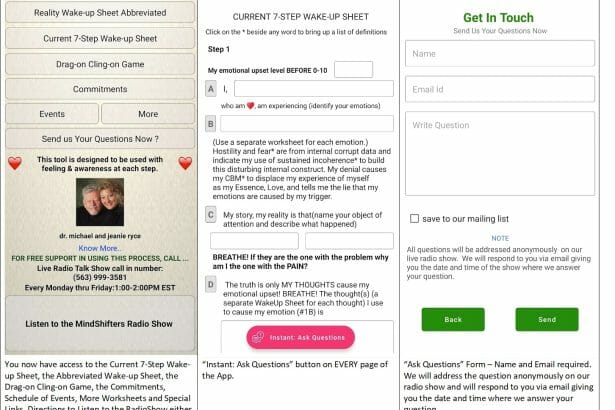
"Recall earlier that I asked when you were most intelligent? You said the only time you had made decisions and done things you regretted was when you were in a state other than Love. Our behavior is only insane when the mind is in the condition of hostility, fear or a reaction to one of those emotions. "True Forgiveness removes from the human system the realities that defile human intelligence, health, prosperity and relationships. It is the key to aliveness." "How do we do this worksheet process? I don't have a clue what subject to do it on. Do you have any suggestions?" "Let's explore the waitress picking up your cup of coffee in the restaurant. I think some of the things revealed in that conversation will be useful to discover how your mind produces its Why Is This Happening To Me . . . AGAIN?! experiences. It should be fertile ground for finding material for several productive worksheets." (Refer to pages 31-34.) "I'm ready to look at everything in my life," Richard confided. He seemed inspired to begin the worksheet process. "Let's look at what your description of the events that day in the restaurant alluded to, and see if any of the issues I think might be there are accurate. For instance, when you were small, were there brothers or sisters that your parents favored over you, perhaps to the point they gave your toys to them?" I probed. "Did you ignore and fight a lot with them?" "Things were always taken from me, I never had anything to myselfbut how do you know that? I don't see how you figured that out." Richard sounded bewildered. "I didn't know it, but I suspected it when you told me, in rough detail, about the waitress picking up your coffee."
"I didn't tell you about my childhood then," Richard countered. I explained to him that "he" didn't, but "his-story" did. Almost everyone experiences their own internal reality in place of what is happening in the world. This means there is a pattern or theme for every reality flowing from brain cells. The words coming from a mind reflect the general patterns contained in the mind of the speaker. Words of delight and inspiration reflect the way life is designed to be, angry words reflect an angry history, sad words a sad past, and fearful words tell the story of a mind brought up in what is perceived as an unsafe world. "Listening to people speak about any reality in their mind gives you a great deal of information about what has happened in their past." We reflected on the idea that the perceptual output of a mind tells you more about the content of that mind than about the object it perceives. "The output of a mind is always based on the content of that mind and may or may not accurately reflect the external world, the world of actuality." We reviewed the actualities from that day in the restaurant and the realities Richard's mind fed him. We distinguished between the two. He had experienced the actuality of a waitress picking up a cup of coffee. His mind fed him the reality from his past that something was being taken away. We discussed the fact that his 'someone's taking something from me' reality surfaced because it was in him to be triggered, not because the waitress took his coffee. His thought that people take things from him was a filter through which he viewed life, and this was his opportunity to use True Forgiveness to change that reality in his mind. He was dismayed and excited, all in one breath. "I didn't know my words made me so transparent and I'm getting a sense of how you figured me out. How did you know I used to ignore my sister and fight a lot?" he asked. "Recall, you said you attacked the waitress without her having a chance to explain? You would likely attack that quickly only if you had built a reality that says something like, 'Attack first. Don't listen. If you listen, you will lose!' It is a common reality in families where parents play favorites." "That's painfully close to my relationship with my sister," he admitted. "Why don't you tell me all about me?" he asked. "You will notice, Richard, that I'm checking out what I'm hearing from you. That is an important step in this process. When I hear your words, I can only hear them for what they trigger in me. My meaning for your words might be totally off base. The key is, what your words trigger in you, not what they mean to me. I always work to keep my insights and feedback in the form of questions so I stay on track. I'm here to support your looking into your issues, not mine. I'm not here to 'tell' you anything. "Words are a topic we could spend hours on, and in some of our intensive workshops we do. A good practice is to observe the words you speak. If you see yourself using words that are not in support of what you truly want to create in your life, use the tools to change your reality structure and your speech.
"Do you have any thoughts about a topic for your worksheet?" | |||||
Special
Book Offer / Reviews / Audio
Clip / Video/Audio
Tape Catalogue
|